
The Formation of Our Solar System
OPENING QUESTIONS: Please take out your planet tyles and arrange them into the following groups:
- Gas Giants (with rings!)
- Rocky Planets
- Asteroids
- Comets
- Moons (how can we tell those are moons and not planets?)
- Dwarf Planets (We don't know very much about those - yet - by the by ? Do we even have any of those in our tiles ?)
OBJECTIVE: I will be able to relate how the solar system was formed to an articulate 6th grader after today's class.
WORD FOR TODAY:
- solar nebula (star nursery)
- super nova (exploding star)
- Sol ("Our Sun")
- Asteroid ("Rocks in space" otherwise known as "Flying Potatoes" )
- Comet ("A dirty snowball")
- Meteor ("Rocks falling to Earth")
- Moon ("A rocky body orbiting a planet")
- Planet ("A spherical body orbiting a star")
- Mercury
- Venus
- Earth
- Mars
- Jupiter *(has rings!)
- Saturn *(has rings!)
- Uranus *(has rings!)
- Neptune *(has rings!)
- Dwarf Planet:
- Pluto
- Eris
- Haumea
- Astronomical Unit (1 AU = 150,000,000 km = ~ 100,000,000 miles)
WORK O' THE DAY:
OBSERVATIONS TONIGHT!!!! (tomorrow got worse, tonight got better!)
Let's check out this ZOOM IN that I just discovered this morning (it is REALLY cool!)
Take a look at this portion of the Eagle nebula called "The Pillars of Creation:"

That is a picture from the Hubble Space Telescope. Check out the same object taken by the James Webb Space Telescope:
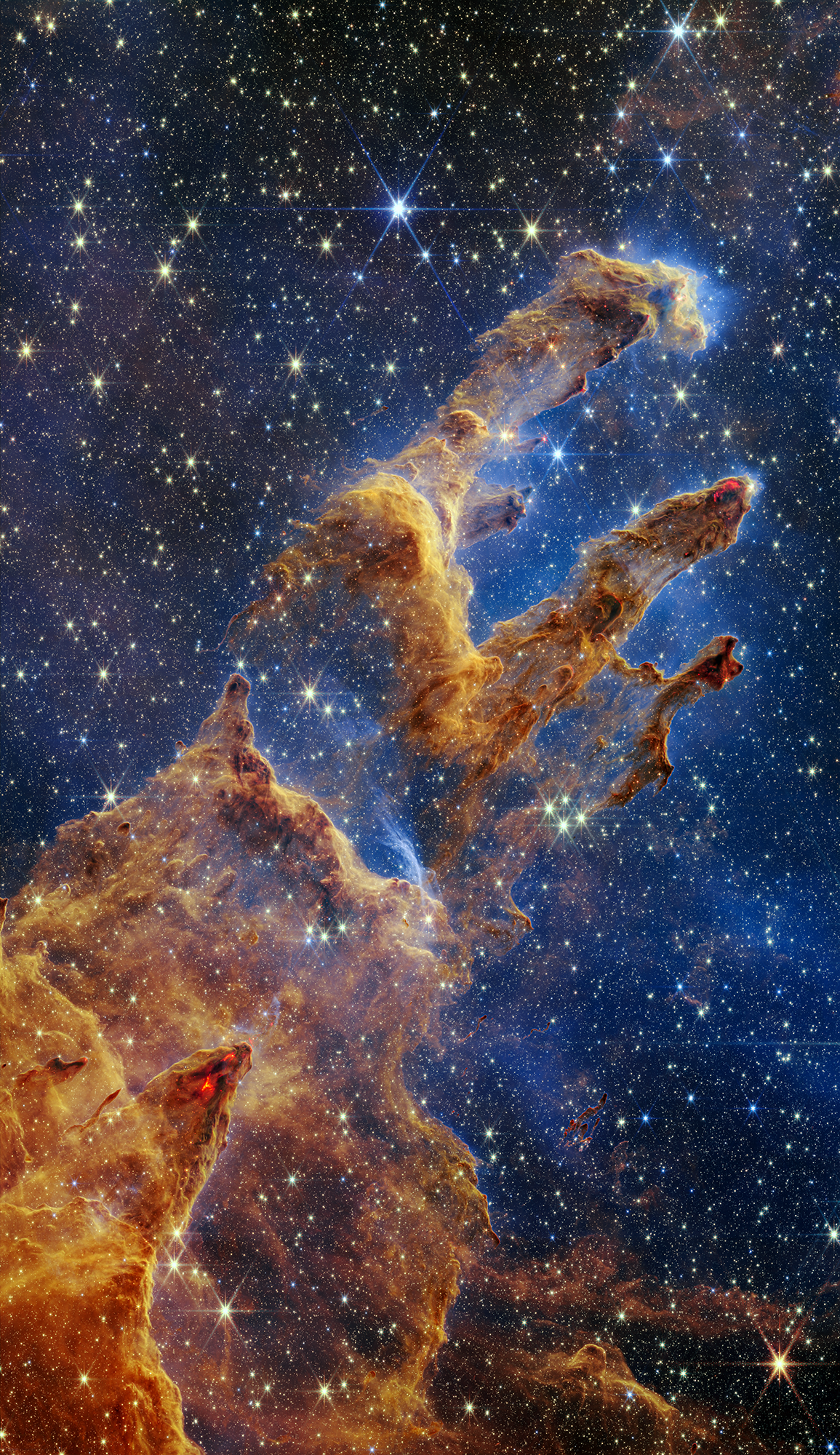
Each of those 'pillars' is approximately 4 light years in length (about the same distance as from our own sun to the closest star, alpha centauri or, if you prefer, about 24 trillion miles or about 40 trillion kilometers).
Recall the name: "Pillars of Creation".
That name was given by astronomers because stars and planets are being created in that nebula right now!
═══════════════════════════
Let's head out in the hallway for some moving around. We'll pretend we're bits of dust and gas in the early Solar Nebula....
═══════════════════════════
Here's a recap of what we just did:
<I will be testing you on ALL of this by the by>
Nebulas are large clouds of dust and gas that are fairly common in our Milky Way galaxy.
Imagine you are such a dust cloud--- minding your own business deep in the spaces between the stars.
All at once a Super Nova happens.... which is to say a massive star blows up and sends a shockwave speeding through space.
That shockwave gets you (remember, you're a nebula!) shimmying and shaking.
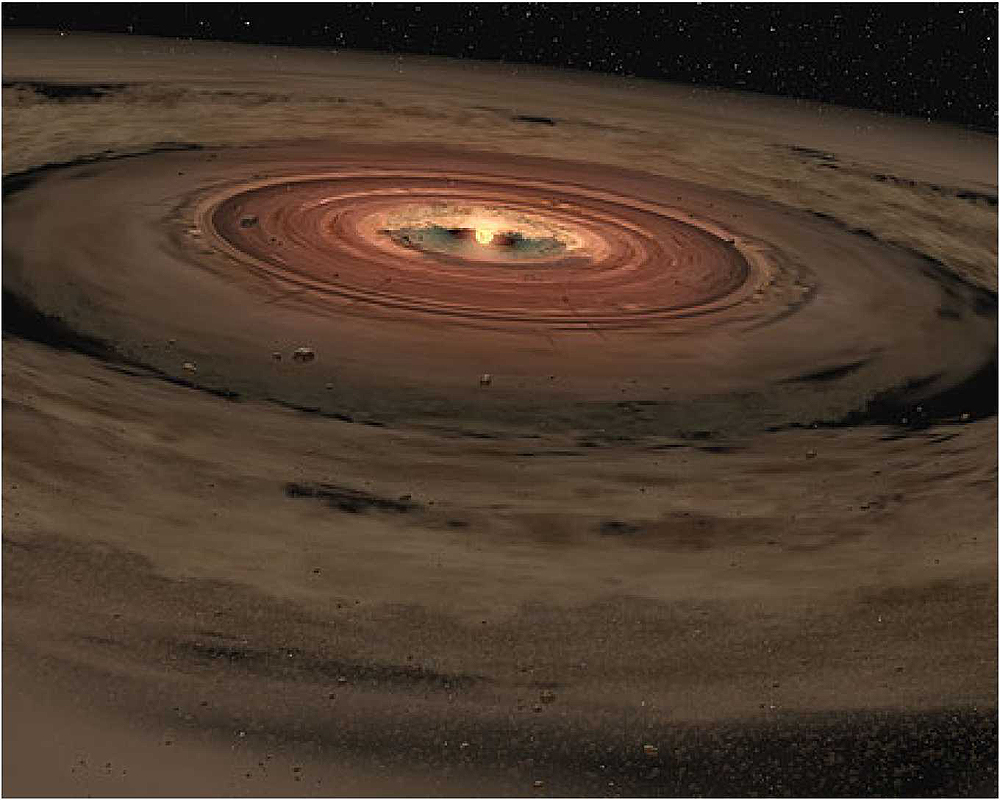
As you start to move, the gravitational attractions of all your bits of dust and gas start pulling you into a cosmic whirlpool.
As you move around and around collisions between the dust and gas occur.
As those collisions occur, friction results.
As friction results, temperatures rise.
As temperatures rise, more energetic collisions occur.
As more high energy collisions occur, temperatures rise.
As temperatures rise, more collisions occur.
As more collisions occur, the temperature rises.
═══════════════════════════
Those processes happen for hundreds of billions of years until the gaseous center of the whirlpool collapses inward to form a star! Our sun was formed this way about 5 billion years ago.
The outer bits of rock and gas continue to circle around, bashing into each other all the time.
The rocky bits condense into rocky planets or asteroids and in fact, our own Earth was formed this way about 4.5 billion years ago.
The other gaseous bits collapse into gaseous planets at the same time.
═══════════════════════════
In our solar system, the rocky bits continued smashing into each other for another
billion years or so, making bigger and bigger planets!
Let's take a gander at THIS
In fact, about 3.5 billion years ago, a Mars-sized planet name Thea smashed into our Earth, almost destroying the Earth:

The heavier materials such as nickel and iron migrated towards the center of the Earth forming a dense, solid core.
The lighter materials shot into nearby space and eventually coalesced into the moon!
Now let's take a few moments to revise our earlier models that we started with earlier today.
═══════════════════════════